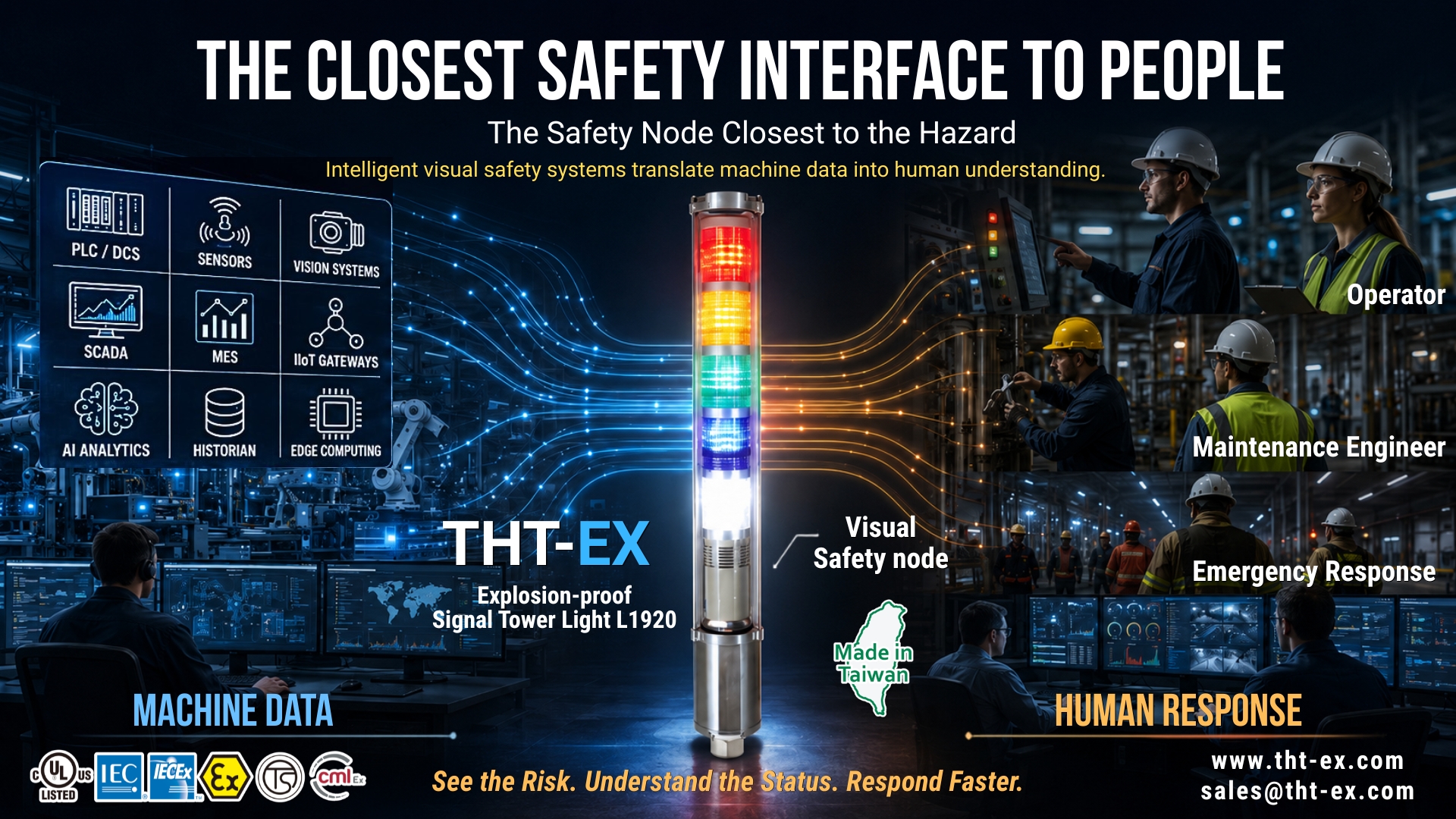
How THT-EX L1920 turns machine signals into safer human response in hazardous and mission-critical environments
In modern industrial facilities, safety is no longer defined only by how much data a system can collect.
Today’s factories, petrochemical plants, LNG terminals, semiconductor facilities, pharmaceutical production lines and AI data centres generate enormous amounts of operational information every second. Sensors monitor temperature, pressure, vibration, gas concentration, power status, equipment performance and process conditions. PLCs, DCS, SCADA, MES platforms and AI monitoring systems process these signals at increasing speed.
Yet one challenge remains unchanged:
Safety still depends on people making the right decision at the right time.
This is where visual safety communication becomes critical.
For many years, tower lights were viewed as simple status indicators. Red meant fault. Yellow meant warning. Green meant normal operation. Their purpose was to attract attention and show basic machine status.
But industrial environments have changed.
Operators, maintenance engineers, safety supervisors and control room teams now face more complex systems, more data, more alarms and shorter response windows. In many facilities, the problem is no longer a lack of information. The real challenge is how to turn information into clear understanding.
This is why the THT-EX L1920 is now positioned not simply as an explosion-proof tower light, but as an Intelligent Visual Safety System.
The L1920 is designed to translate machine status, process signals, alarms and operator response needs into clear visual and audible communication. It helps people on site quickly understand what is happening, where attention is required and how urgently they need to respond.
In this role, the L1920 becomes more than a warning device.
It becomes the closest safety interface to people and the safety node closest to the hazard.
Installed near equipment, control panels, process skids or hazardous-area machinery, it provides a direct communication layer between automated systems and the people responsible for action. Instead of relying only on screens, control room messages or scattered alarms, visual signalling brings critical status information back to the field, where decisions and responses often begin.
The value of this approach is especially clear in hazardous and mission-critical environments.
In petrochemical and LNG facilities, visual and audible signalling can support equipment status indication, process alarms, loading operations and emergency response. In semiconductor chemical supply systems, it can help communicate tool status, chemical delivery conditions and process deviations. In AI data centres, it can support awareness of power, cooling, network and maintenance status. In pharmaceutical and clean process environments, it can help align operators, maintenance teams and supervisors around shared operating conditions.
Across these industries, the operational pain points are similar:
too many signals competing for attention
alarms that may be delayed or misunderstood
equipment status that is not immediately visible at the field level
maintenance teams arriving without a clear understanding of the current condition
critical decisions that must be made under time pressure
An intelligent visual safety system helps reduce these gaps by turning complex system information into a shared visual language.
The L1920 can support different colour meanings based on customer requirements. Red may indicate fault, stop or danger. Yellow may indicate warning or abnormal trends. Green may indicate normal operation. Blue may request operator or maintenance support. White may be assigned to standby, cleaning, quality check or customised production status.
This is not only about colour.
It is about making industrial communication faster, clearer and more consistent.
In hazardous areas, this becomes even more important. Any device installed in explosive or high-risk environments must not only communicate clearly, but also operate safely under demanding conditions. For this reason, certified explosion-proof design remains a core part of the L1920 value proposition.
As industrial facilities continue to adopt automation, AI, IIoT and digital monitoring, the future of safety will not depend only on generating more information. It will depend on how effectively that information reaches the right people in a form they can understand immediately.
The THT-EX L1920 Intelligent Visual Safety System reflects this shift.
It transforms the traditional role of a tower light from passive indication into active safety communication — helping operators see the status, understand the risk and respond faster.
THT-EX L1920 Intelligent Visual Safety System
See the Status. Understand the Risk. Respond Faster.
sales@tht-ex.com
#SignalTowerLight #IndustrialLighting #OffshoreDrilling #LightingSolutions #LEDLighting #LightingSolutions #thtex #greenenergy #hazardouslocation #IndustrialLighting #safetyfirst #HydrogenEnergy #Decarbonization #EPC
