HAZARDOUS AREA ENGINEERING BEYOND PRODUCT COMPLIANCE
https://www.manufacturingtechnologyinsightsapac.com/tht-ex-2026
Originally published by HazardEx
A hazardous-area lighting purchase can pass a certification review and still create trouble after installation. Heat, corrosive air, vibration, dust and continuous duty expose weaknesses that rarely appear in a catalog comparison. Buyers therefore face a narrower question than whether equipment carries the required marks. They must determine whether the supplier understands how certified products behave after years inside demanding plants.
Long-term performance begins with application fit. A luminaire designed for a moderate indoor zone may not suit a coastal petrochemical site or a high-temperature process area. Housing design, thermal control, sealing and material selection all affect service life. Procurement teams should look beyond nominal ratings and ask how field conditions influence product design, validation and revision. A broad catalog offers little protection when the supplier cannot explain why one configuration belongs in a particular environment.
Certification remains essential, but it should function as an entry threshold rather than the end of due diligence. Buyers working across regions need equipment aligned with the standards governing each site. They also need documentation that supports engineering review and later inspection. The deeper distinction lies in how certification knowledge connects to actual manufacturing discipline. Air-tightness checks, pressure testing, electrical safety verification and final functional review reduce variation between approved designs and shipped units.
Hazardous-area projects also become harder when lighting is treated as an isolated purchase. Power distribution, cable assemblies, connectors and visual signaling often meet at the same installation point. Separate suppliers can introduce interface gaps, mismatched specifications, installation rework and repeated approval cycles. A provider that understands the electrical path around the fixture can reduce coordination burden and help buyers resolve compatibility questions before site work begins.
Visual communication adds another layer. Automated plants already produce more alarms than people can comfortably interpret. Warning devices must now convey machine status clearly to operators while remaining suitable for explosive atmospheres. Buyers should examine whether a supplier can connect certified visual signaling with broader industrial electrical systems without turning the project into a collection of unrelated devices. Clear status communication matters most during abnormal conditions, when delay or ambiguity can widen the consequence of a small fault.
Manufacturing depth deserves equal scrutiny. Precision machining, standardized assembly, automated fastening and repeatable testing can improve consistency, but the value lies in how these controls are tied to verification. Field feedback should also return to engineering. Suppliers that study corrosion, temperature stress, humidity damage and installation failure can revise designs around observed conditions rather than assumptions.
THT-EX combines certified hazardous-area equipment with electrical connection technologies and power distribution under one engineering platform.
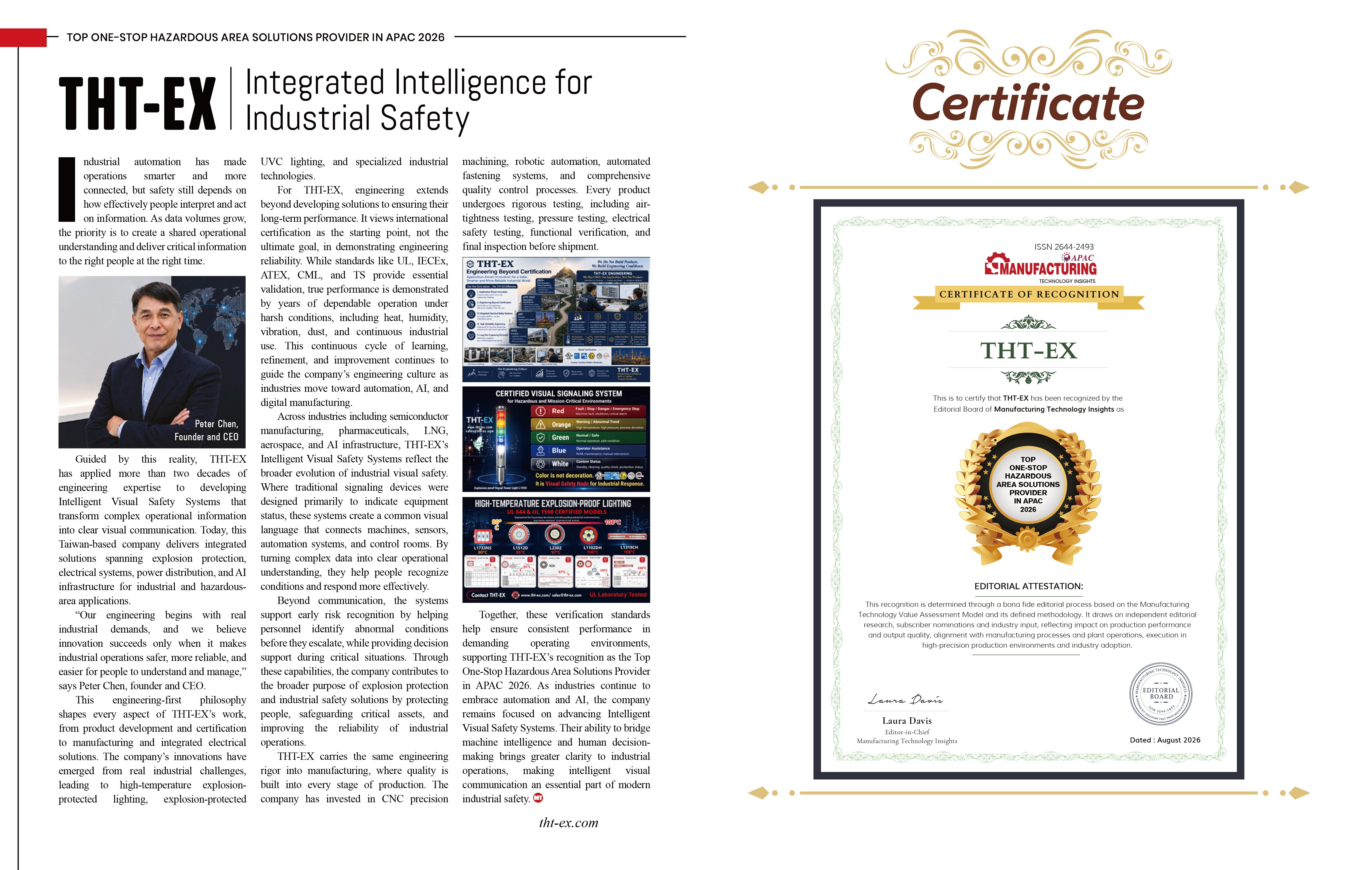
THT-EX approaches hazardous-area work as an integrated electrical engineering challenge rather than a lighting-only application. It combines certified hazardous-area equipment with electrical connection technologies and power distribution under one engineering platform. The company’s scope includes high-temperature explosion-protected lighting, explosion-protected UVC lighting, and Intelligent Visual Safety Systems designed for demanding industrial environments. International certifications like UL, IECEx, ATEX, and CML support applications across global markets, while in-house CNC machining, standardized production processes, automated fastening systems, and comprehensive testing strengthen manufacturing control. This integrated approach enables THT-EX to support customers seeking coordinated lighting and hazardous-area electrical solutions.
Integrated Intelligence for Industrial Safety
Industrial automation has made operations smarter and more connected, but safety still depends on how effectively people interpret and act on information. As data volumes grow, the priority is to create a shared operational understanding and deliver critical information to the right people at the right time.
Guided by this reality, THT-EX has applied more than two decades of engineering expertise to developing Intelligent Visual Safety Systems that transform complex operational information into clear visual communication. Today, this Taiwan-based company delivers integrated solutions spanning explosion protection, electrical systems, power distribution, and AI infrastructure for industrial and hazardous-area applications.
“Our engineering begins with real industrial demands, and we believe innovation succeeds only when it makes industrial operations safer, more reliable, and easier for people to understand and manage,” says Peter Chen, founder and CEO.
This engineering-first philosophy shapes every aspect of THT-EX’s work, from product development and certification to manufacturing and integrated electrical solutions. The company’s innovations have emerged from real industrial challenges, leading to high-temperature explosion-protected lighting, explosion-protected UVC lighting, and specialized industrial technologies.
For THT-EX, engineering extends beyond developing solutions to ensuring their long-term performance. It views international certification as the starting point, not the ultimate goal, in demonstrating engineering reliability. While standards like UL, IECEx, ATEX, CML, and TS provide essential validation, true performance is demonstrated by years of dependable operation under harsh conditions, including heat, humidity, vibration, dust, and continuous industrial use. This continuous cycle of learning, refinement, and improvement continues to guide the company’s engineering culture as industries move toward automation, AI, and digital manufacturing.
Across industries including semiconductor manufacturing, pharmaceuticals, LNG, aerospace, and AI infrastructure, THT-EX’s Intelligent Visual Safety Systems reflect the broader evolution of industrial visual safety. Where traditional signaling devices were designed primarily to indicate equipment status, these systems create a common visual language that connects machines, sensors, automation systems, and control rooms. By turning complex data into clear operational understanding, they help people recognize conditions and respond more effectively.
Beyond communication, the systems support early risk recognition by helping personnel identify abnormal conditions before they escalate, while providing decision support during critical situations. Through these capabilities, the company contributes to the broader purpose of explosion protection and industrial safety solutions by protecting people, safeguarding critical assets, and improving the reliability of industrial operations.
THT-EX carries the same engineering rigor into manufacturing, where quality is built into every stage of production. The company has invested in CNC precision machining, robotic automation, automated fastening systems, and comprehensive quality control processes. Every product undergoes rigorous testing, including air-tightness testing, pressure testing, electrical safety testing, functional verification, and final inspection before shipment.
Together, these verification standards help ensure consistent performance in demanding operating environments, supporting THT-EX’s recognition as the Top One-Stop Hazardous Area Solutions Provider in APAC 2026. As industries continue to embrace automation and AI, the company remains focused on advancing Intelligent Visual Safety Systems. Their ability to bridge machine intelligence and human decision-making brings greater clarity to industrial operations, making intelligent visual communication an essential part of modern industrial safety.
https://www.manufacturingtechnologyinsights.com/a/hazardous-area-solution-providers-in-apac
