Maintenance Is Not Optional. It Is Part of Safety.
No Inspection. No Maintenance. Shorter Life. Higher Risk.
Originally published by HazardEx (Hazloc Safety Media & Events). Reproduced with permission.
Hazardex (Hazloc Safety Media & Events)’ https://www.linkedin.com/company/hazardex
What five years on the front line taught us about hazardous area equipment design
In 2011, we completed the development of the first-generation hazardous area LED luminaire. Like many engineering teams, we believed we had done everything right. The product complied with international certification requirements, passed laboratory testing and met customer specifications, reflecting considerable effort in explosion protection, ingress protection, corrosion resistance, thermal management and mechanical integrity.
At that point, we believed the design was complete. Looking back, we had only completed the laboratory stage. The product was laboratory-qualified, but the field became our real teacher. The real engineering work had not yet begun.
The Front Line
The first-generation luminaires were installed at a major coastal petrochemical complex near Taichung on Taiwan's west coast. Operating conditions varied, but the most severe exposure occurred along the front row facing directly toward the Taiwan Strait.
These luminaires were continuously subjected to salt-laden sea air, seasonal monsoons, typhoons, high humidity, industrial contaminants, UV radiation, and daily thermal cycling. Together, these factors created an aggressive micro-environment that accelerated long-term corrosion—a cumulative effect we initially underestimated.
Five Years Later - The Environment Challenged Our Design
Approximately five years later, well after the warranty period had expired, we returned to inspect the installation. We wanted to evaluate how the luminaires performed after years of continuous exposure in one of Taiwan's most demanding industrial environments.
The electrical performance was reassuring: the luminaires were still operating and producing light. However, the mechanical condition told a very different story.
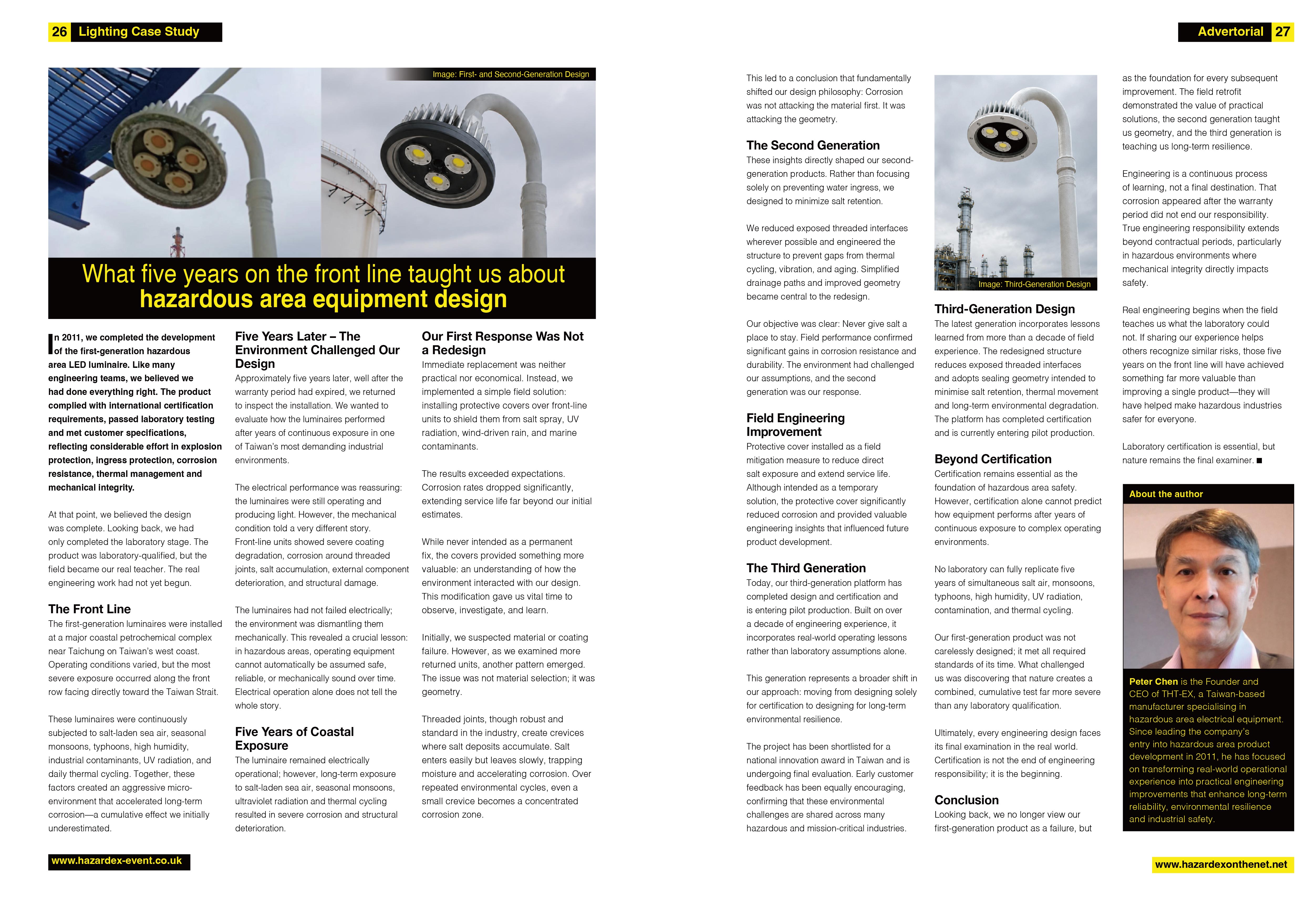
Front-line units showed severe coating degradation, corrosion around threaded joints, salt accumulation, external component deterioration, and structural damage.
The luminaires had not failed electrically: the environment was dismantling them mechanically. This revealed a crucial lesson: in hazardous areas, operating equipment cannot automatically be assumed safe, reliable, or mechanically sound over time. Electrical operation alone does not tell the whole story.
Five Years of Coastal Exposure
The luminaire remained electrically operational; however, long-term exposure to salt-laden sea air, seasonal monsoons, ultraviolet radiation and thermal cycling resulted in severe corrosion and structural deterioration.
Our First Response Was Not a Redesign
Immediate replacement was neither practical nor economical. Instead, we implemented a simple field solution: installing protective covers over front-line units to shield them from salt spray, UV radiation, wind-driven rain, and marine contaminants.
The results exceeded expectations. Corrosion rates dropped significantly, extending service life far beyond our initial estimates.
While never intended as a permanent fix, the covers provided something more valuable: an understanding of how the environment interacted with our design. This modification gave us vital time to observe, investigate, and learn.
Initially, we suspected material or coating failure. However, as we examined more returned units, another pattern emerged. The issue was not material selection: it was geometry.
Threaded joints, though robust and standard in the industry, create crevices where salt deposits accumulate. Salt enters easily but leaves slowly, trapping moisture and accelerating corrosion. Over repeated environmental cycles, even a small crevice becomes a concentrated corrosion zone.
This led to a conclusion that fundamentally shifted our design philosophy: Corrosion was not attacking the material first. It was attacking the geometry.
The Second Generation
These insights directly shaped our second-generation products. Rather than focusing solely on preventing water ingress, we designed to minimize salt retention.
We reduced exposed threaded interfaces wherever possible and engineered the structure to prevent gaps from thermal cycling, vibration, and aging. Simplified drainage paths and improved geometry became central to the redesign.
Our objective was clear: Never give salt a place to stay. Field performance confirmed significant gains in corrosion resistance and durability. The environment had challenged our assumptions, and the second generation was our response.
Field Engineering Improvement
Protective cover installed as a field mitigation measure to reduce direct salt exposure and extend service life.
Although intended as a temporary solution, the protective cover significantly reduced corrosion and provided valuable engineering insights that influenced future product development.
The Third Generation
Today, our third-generation platform has completed design and certification and is entering pilot production. Built on over a decade of engineering experience, it incorporates real-world operating lessons rather than laboratory assumptions alone.
This generation represents a broader shift in our approach: moving from designing solely for certification to designing for long-term environmental resilience.
The project has been shortlisted for a national innovation award in Taiwan and is undergoing final evaluation. Early customer feedback has been equally encouraging, confirming that these environmental challenges are shared across many hazardous and mission-critical industries.
Third-Generation Design
The latest generation incorporates lessons learned from more than a decade of field experience. The redesigned structure reduces exposed threaded interfaces and adopts sealing geometry intended to minimise salt retention, thermal movement and long-term environmental degradation.
The platform has completed certification and is currently entering pilot production.
Beyond Certification
Certification remains essential as the foundation of hazardous area safety. However, certification alone cannot predict how equipment performs after years of continuous exposure to complex operating environments.
No laboratory can fully replicate five years of simultaneous salt air, monsoons, typhoons, high humidity, UV radiation, contamination, and thermal cycling.
Our first-generation product was not carelessly designed; it met all required standards of its time. What challenged us was discovering that nature creates a combined, cumulative test far more severe than any laboratory qualification.
Ultimately, every engineering design faces its final examination in the real world. Certification is not the end of engineering responsibility; it is the beginning.
Conclusion
Looking back, we no longer view our first-generation product as a failure, but as the foundation for every subsequent improvement. The field retrofit demonstrated the value of practical solutions, the second generation taught us geometry, and the third generation is teaching us long-term resilience.
Engineering is a continuous process of learning, not a final destination. That corrosion appeared after the warranty period did not end our responsibility. True engineering responsibility extends beyond contractual periods, particularly in hazardous environments where mechanical integrity directly impacts safety.
Real engineering begins when the field teaches us what the laboratory could not. If sharing our experience helps others recognize similar risks, those five years on the front line will have achieved something far more valuable than improving a single product-they will have helped make hazardous industries safer for everyone.
Laboratory certification is essential, but nature remains the final examiner.
About the author
Peter Chen is the Founder and CEO of THT-EX, a Taiwan-based manufacturer specialising in hazardous area electrical equipment.
Since leading the company's entry into hazardous area product development in 2011, he has focused on transforming real-world operational experience into practical engineering improvements that enhance long-term reliability, environmental resilience and industrial safety.
